


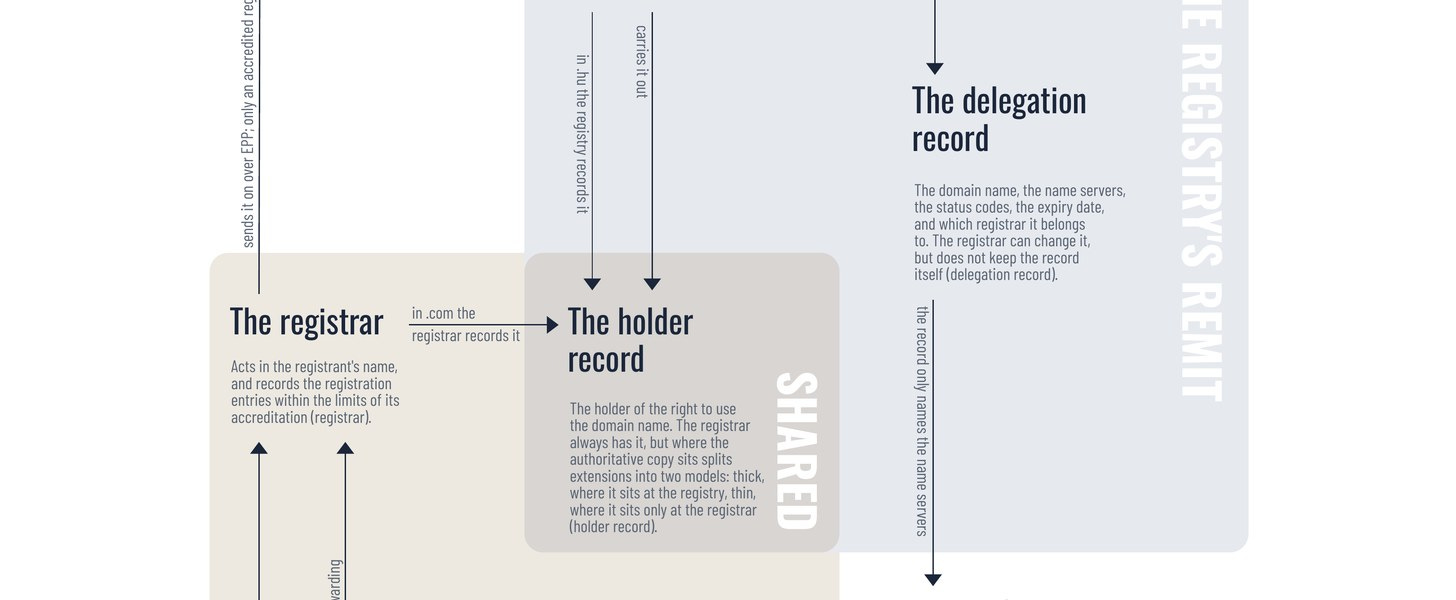
The second map of the domainblog is a true concept map. With this map, one can clearly oversee a domain’s registry entry. While the previous map, [”The Path of Name Resolution”](https://gluerecord.com/p/the-path-of-name-resolution) showed how a question typed into a browser, that is the domain name, becomes an answer, this map shows what this answer is formed based upon.
The map of the domain registry entry shows what belongs to whose scope of authority among the actors, and who can modify the entry and where.
The registry entry can be broken down into two halves on a conceptual level. One belongs to the registrar’s scope of authority, the other belongs to the registry’s scope of authority. These two scopes of authority intersect each other in an interesting way. Not functionally and not structurally, much rather on a policy level. This means that it is decided along the policy of the domain ending, who keeps the record of the domain user right’s entry.
The domain user entry keeps a record of the possessor of the domain name's right of use. The delegation entry keeps a record of the domain name, the registrar, the expiration date and the status indicators, and for a delegated domain the name servers as well. The delegation entry is a concept of its own, not the delegation itself. Delegation is an event: making the domain name technically usable.
On the map of the registry entry we placed two radically different endings next to each other: the .com and the .hu endings. The .com operates in the so-called thin model, while the .hu operates in the so-called thick model. In the thick model, the domain user entry is at the registry. And in the thin model, the domain user entry is at the registrar. This is a fundamental difference, which determines the structural and policy operation of the two endings.
The dispositions of the domain user set the chain in motion, which can be either the initial domain request, or a later modification disposition. At the same time, the domain user freely disposes of their DNS settings, within the delegation entry. They can rewrite the domain’s zone at the DNS operator at any time, even immediately, and this is where this concept map connects to our [”The Path of Name Resolution”](https://gluerecord.com/p/the-path-of-name-resolution) map.
Besides the outlined structural actors of the domain user entry and the delegation entry, external actors also have an impact on these. Their common denominator is: the law, the legislation, and the regulation. At the same time, these can also function as a filter, even as a pre-filter, they can function as a later dispute resolver, but also as an authoritative decision-maker directly enforceable at the registry, such as the court.
The life path of a domain name, and the rights and possibilities of the domain user are far more complex than calling our registrar on the phone, or writing an e-mail to them, or even modifying a few data on the control panel.
The structural build-up and operation of a domain is not merely a technical given, not a technological question. The most emphasized element is where and who keeps the record, who registers who the possessor of the domain’s right of use is. This is purely a regulatory question, and not a technical one, and the regulation is the swampy terrain of Tarkovsky’s Zone, it changes ending by ending.
Download the map: The Registration Record — PDF, A3, v1.0
You are entirely free to share, print, or use this map in your presentations, provided you give proper credit. Since it is released under a CC BY-ND 4.0 license, please leave the graphic exactly as it is. That means no relabeling, redrawing, or merging it into other visuals. Need a translation or want to adapt it for your own materials? Just drop me a message beforehand. If you find an error in it, write to me and I will fix it in the next version.
Magyar változat: [zona.hu/a-nyilvantartasi-bejegyzes/]